
GrooveFX · The drum course
DrumKlass
Slow it down. Bring it up. Make it stick.
Drum lessons from your first stroke to intermediate, step by step, judged as you play. Practise each exercise slowly, bring it up to tempo, then pass its test on a MIDI kit, your keyboard or a microphone.
MIDI kit · keyboard · microphoneHow a lesson goes
Hear it. Practise it slowly. Then pass the test.
Every lesson is a few short exercises, written as drum notation and played on a 3D kit. Each one has a start tempo, where you can play it clean, and a goal tempo the lesson asks for.
-
1 Listen DrumKlass plays the exercise for you on its 3D kit, so you know how it should sound before you play it.
-
2 Practise It loops while you play, every hit shown as it is judged. The tempo stays where you set it, rung by rung.
-
3 Test A set number of passes at one tempo, with nothing shown until the end: played on your own sense of time.
-
4 Earn its stars Pass at the goal tempo for two stars, and again on another day for the third. Then the next rung, or the next lesson.
The course
Fourteen units. 111 lessons.
In the order drum teachers build a player: counting and the hands, then the feet, the rock beat, the rudiments, grooves, fills and feel, and on into styles, the classic records and advanced skills. Every lesson is open from the start; a unit's last lesson is its level check.
- Unit 1 · 7 lessons
First steps
Hold the sticks, count the pulse, and put hands and feet together in your first rock beat.
- Unit 2 · 7 lessons
Hands
Sixteenth notes and the rudiments behind every fill: singles, doubles, the paradiddle, accents, moving around the kit, and the short rolls.
- Unit 3 · 7 lessons
Grooves
The beats behind most pop and rock songs: bass-drum variations, two-bar grooves, ride and open hi-hat, sixteenths, four on the floor and half-time.
- Unit 4 · 10 lessons
Fill basics
Groove, then fill: count four-bar phrases, play fills of one beat, half a bar, a bar and two bars, learn every sixteenth and triplet cell on one beat, vary any fill five ways, and land every one on the crash.
- Unit 5 · 7 lessons
Feel
Ghost notes and accents, triplets, the shuffle, 12/8 and flams: what makes the same notes groove.
- Unit 6 · 8 lessons
Fill vocabulary
The fill families drummers build on: triplet fills, fills with space, moving accents round the kit, hands with the bass drum, bass drum doubles, dynamic fills and the hits that end a song.
- Unit 7 · 7 lessons
Fill craft
The later families of the Encyclopedia of Drum Fills: half-time fills, double-stroke rolls, sextuplets, rudiments on the kit, displaced fills and fills orchestrated across cymbals, toms and bass drum.
- Unit 8 · 7 lessons
Intermediate
Sixteenth-note bass drum, ghost-note funk, linear grooves and fills, paradiddle grooves, the six-stroke roll and odd meters.
- Unit 9 · 9 lessons
Styles
The grooves of the big styles on the kit: Motown and soul, reggae, bossa nova and samba, Afro-Cuban, jazz time, the country train beat and Middle-Eastern rhythms, and a fill in each style.
- Unit 10 · 10 lessons
Rock legends
The grooves of the rock records every drummer learns: the stomp of the classics, Bonham, AC/DC and Copeland, then grunge, punk, indie and metal.
- Unit 11 · 7 lessons
Pop, soul and dance hits
The grooves under the biggest pop, soul and dance records.
- Unit 12 · 10 lessons
Funk, breaks and shuffles
The funk and hip-hop breaks, the funk bands, fusion and neo-soul, the R&B grooves and the great shuffles.
- Unit 13 · 7 lessons
Famous fills and intros
The fills and intros everyone knows, played coming out of the groove.
- Unit 14 · 8 lessons
Advanced
Double bass drum, sextuplets and gospel chops, linear fills in fives, polyrhythms, 7/4 and 5/8, the fast metal beats, and the half-time shuffle with a metric modulation.
The tempo ladder
Up to tempo, one rung at a time.
The ladder climbs from an exercise's start tempo to its goal in steps of about 5 bpm, and the next test is offered one rung above your fastest pass. What you passed comes back for review after 1, 3, 7, 14, 30 and 60 days, so it stays in your hands.
-
One star
A test passed at the start tempo or faster. The exercise counts as done, and the lesson moves on.
-
Two stars
A test passed at the goal tempo: the tempo the lesson asks for. A unit's level check asks for two stars on each exercise.
-
Three stars
The goal tempo again, on another day. What you can still play the next morning is learnt.
Ways to play
On your kit, your keyboard or your practice pad.
-
An electronic kit
Plug in any electronic drum kit over MIDI. Its pads play the drums they are, and every hit lands on the 3D kit and is judged, to the millisecond.
-
The keyboard
The same keys as DrumFX and BeatFX: A for the hi-hat, S for the snare, X for the kick, D, F and G for the toms, E and H for the cymbals, Z for the pedal.
-
A microphone
An acoustic kit or a practice pad, heard through your computer's microphone. A microphone can't tell the drums apart, so these runs are judged for timing.
- FreeEvery unit and every lesson, no trial.
- In your browserNothing to install on a computer or a tablet.
- Saved as you goEvery run is kept in this browser, in a practice journal.
- On every deviceSign in with Google and your progress follows you.
 Also from GrooveFX
DrumFX
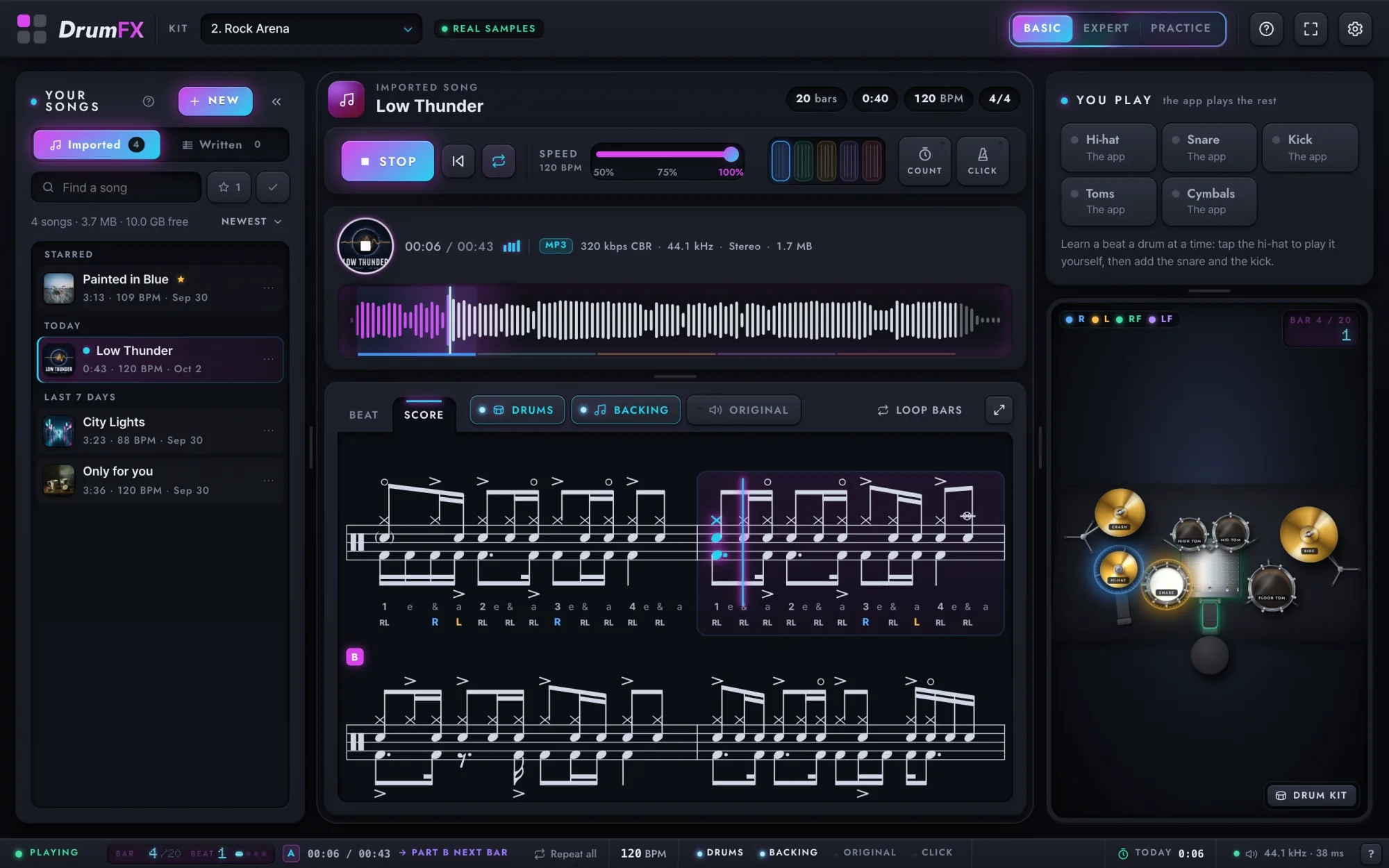
Learnt a groove? Play it in a real song. Drop an MP3 into DrumFX: it takes the drums out, writes them down and lets you play along with the band.
What DrumFX does
Also from GrooveFX
DrumFX
Learnt a groove? Play it in a real song. Drop an MP3 into DrumFX: it takes the drums out, writes them down and lets you play along with the band.
What DrumFX does
 Also from GrooveFX
BeatFX
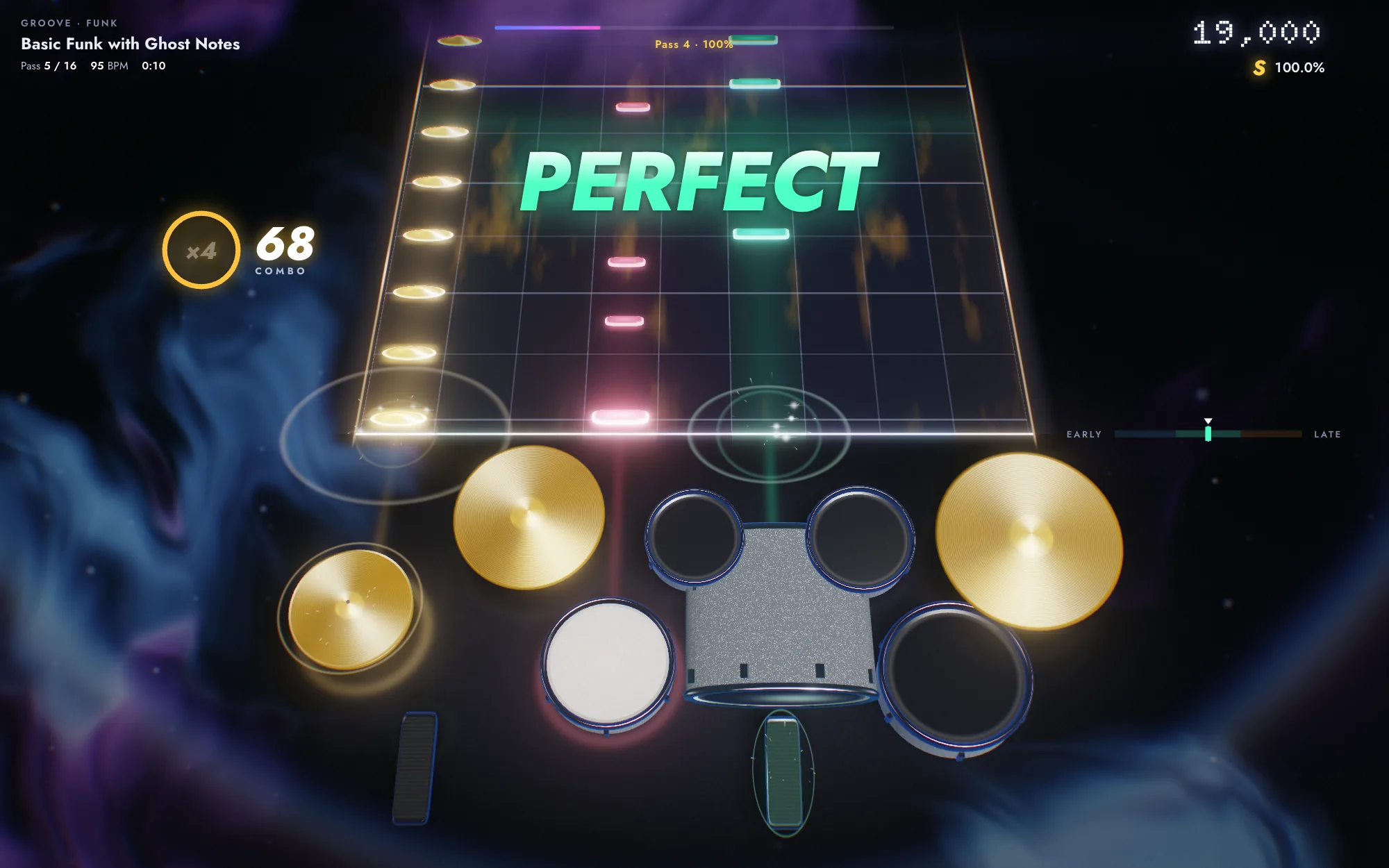
Want to play for points? In BeatFX, 448 grooves and 280 fills fall onto a 3D kit, and every hit is judged on the way to a grade.
How BeatFX plays
Also from GrooveFX
BeatFX
Want to play for points? In BeatFX, 448 grooves and 280 fills fall onto a 3D kit, and every hit is judged on the way to a grade.
How BeatFX plays
Sticks up. Lesson one.
Free, in your browser. A MIDI kit, a keyboard or a microphone is all it takes.